Ordering a Custom Display Case? What to Know Before You Order
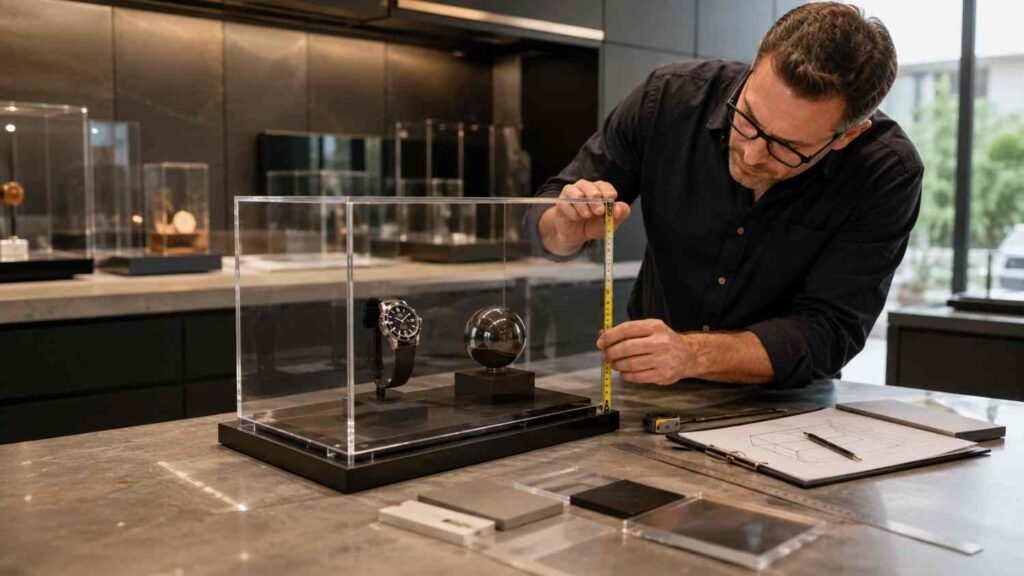
Getting the dimensions right is important, but size alone is not enough. A custom display case should be designed around the object, how it will be accessed, and where it will be installed. A case can fit an item and still be difficult to clean, awkward to access, too heavy to move, or poorly suited to the space.
Before requesting a quote, consider the usable interior dimensions, material, access method, shelving, security, lighting, installation conditions, and delivery requirements.
Start With What You Are Displaying
Begin with the item itself. Record:
- Height, width, and depth
- Approximate weight
- Number of items
- How each item will be positioned
- Whether anything extends beyond the main body
- Whether the display will change later
Include bases, stands, handles, mounts, cables, packaging, and other components in your measurements. A collectible that measures 18 inches high, for example, may need additional clearance above it so it can be placed into or removed from the case safely.
Know the Difference Between Interior and Exterior Dimensions
Do not assume the outside dimensions of a case tell you how much usable space is available inside. Material thickness, shelves, tracks, frames, doors, hardware, and bases can reduce the interior space. When requesting a quote, clearly identify:
- Object dimensions
- Minimum usable interior dimensions
- Maximum exterior dimensions
This helps prevent a case from arriving with less usable space than expected.
Leave Enough Clearance Around the Item
Avoid designing the enclosure to fit the object too tightly. Extra space may be needed for:
- Installing and removing the item
- Cleaning the interior
- Repositioning products
- Reaching behind the object
- Adding mounts or labels
If the case will be accessed frequently, practical handling space is just as important as appearance.
Measure the Delivery and Installation Route
A case may fit perfectly in its final location but still be difficult to move through the building. Measure:
- Doorways
- Hallways
- Elevators
- Stairwells
- Corners
- Building entrances
- Loading areas
For larger cases, ask whether the unit will arrive fully assembled, partially assembled, or in modular sections. Also confirm:
- Whether freight shipping is required
- Who handles unloading
- Whether assembly is needed
- How the case will be protected during shipping
- Whether replacement components are available if something is damaged
Considering delivery before fabrication can prevent a case from being built in a size or configuration that is difficult to install.
Choose the Right Material
Acrylic and glass are both common display case materials, but each suits different applications.
| Consideration | Acrylic | Glass |
| Weight | Lighter | Heavier |
| Impact resistance | Generally better | Depends on glass type |
| Scratch resistance | More prone to scratching | Generally better |
| Custom fabrication | Highly flexible | More limited for complex shapes |
| Handling | Easier for larger cases | Can be harder to move |
| Appearance | Clean, modern | Traditional, premium |
Acrylic is often preferable for large cases, unusual dimensions, custom cutouts, or projects where reduced weight matters. Glass may make more sense where scratch resistance and a traditional appearance are priorities.
Manufacturers may also offer clear, frosted, colored, UV-filtering, abrasion-resistant, or anti-static acrylic depending on the application.
Decide How the Case Should Open
Access should be planned around how frequently the contents will change. A removable cover may work for long-term collectibles, while retail displays may need hinged or sliding doors for regular restocking. Possible access options include:
- Hinged doors
- Sliding doors
- Removable panels
- Lift-off covers
- Rear-access panels
Also consider the surrounding space. A hinged door may not work well in a narrow aisle if there is not enough clearance for it to open fully.
Plan Shelves Around the Items
Do not choose shelves based only on quantity. Consider:
- Weight placed on each shelf
- Shelf width
- Product height
- Desired spacing
- Whether the layout will change
- Whether shelves need to be removable
Adjustable shelving works well for changing retail displays, while fixed shelving may suit a permanent collection. For heavier items, ask about recommended shelf material, thickness, support, and load capacity. If lighting is required, include it in the original design.
Choose the Right Base and Background
Not every case needs to be transparent on all sides. A backing panel can:
- Hide wiring
- Reduce visual clutter
- Provide contrast
- Conceal mounting hardware
A base can raise the item, hide electrical components, provide support, or help secure the case to a counter or pedestal. Think about the full presentation rather than treating the transparent enclosure as the only important part of the display.
Match Security to the Value and Risk
A lock is not automatically the same as strong security. First decide what the case needs to prevent. For lower-risk displays, simply limiting casual handling may be enough. Retail products, memorabilia, or higher-value collectibles may require keyed locks or restricted access.
For more valuable or irreplaceable items, consider mounting, hinges, locking points, and how the case attaches to its supporting surface. We can also add locking and access-control options to our collectable display cases based on the level of protection you need.
Consider Cleaning and Maintenance
Think about how the case will be maintained once it is in use. Ask:
- Can every interior surface be reached?
- Can shelves be removed?
- How often will the case be opened?
- Are fingerprints likely to be a problem?
- Will the display be exposed to significant dust?
Acrylic also requires appropriate cleaning methods to reduce the risk of unnecessary scratching. If several employees will maintain the case, ask the manufacturer what cleaning products and procedures they recommend.
Understand What Can Be Customized
The term “custom” can mean different things from one supplier to another. Some companies may only resize an existing model, while others can fabricate unusual shapes, custom components, or complete display systems. Customization may include:
- Dimensions
- Materials
- Material thickness
- Shelves
- Doors
- Locks
- Bases
- Cutouts
- Lighting provisions
- Mounting
- Internal dividers
- Product stands
- Colors and finishes
For curved panels, cable openings, custom cutouts, mounts, stands, or other non-standard requirements, our custom plastic fabrication services give us more flexibility to build around the actual application.
As a custom display case manufacturer in Phoenix, AZ, we can work from your dimensions, material preferences, access requirements, shelving, and other specifications to develop a case around the project.
Ordering Multiple Display Cases? Check Repeatability
For bulk orders, consistency matters as much as customization. Ask about:
- Dimensional consistency
- Material consistency
- Hardware availability
- Finish consistency
- Production capacity
- Packaging
- Future repeat orders
For larger or repeat orders, we can supply display cases wholesale to businesses in Tempe, Tucson, and beyond while maintaining consistency across dimensions, materials, hardware, and finishes. For larger production runs, reviewing a prototype or first unit before full production may also be worthwhile.
What Should You Send When Requesting a Quote?
A complete quote request reduces guesswork and unnecessary revisions.
Object Details
Provide:
- Height, width, and depth
- Weight
- How the items will be positioned
Case Details
Specify:
- Minimum interior dimensions
- Maximum exterior dimensions
- Preferred material
- Shelves
- Access method
- Security requirements
- Lighting
- Base or backing requirements
Installation Details
Include:
- Countertop, wall-mounted, or freestanding use
- Available installation space
- Delivery access
- Assembly requirements
- Whether the case will be moved
Order Details
Provide:
- Quantity
- Delivery location
- Required completion date
- Whether repeat orders are likely
When you order our custom-size acrylic display cases, sharing these details upfront helps us understand the application, recommend suitable materials and features, and reduce unnecessary revisions.
Get a Display Case That Fits Right the First Time
Based in Arizona, Instant Display Cases Co. works with businesses, retailers, collectors, museums, and other customers across the USA that need cases designed around specific objects, spaces, and applications.
Whether you need one acrylic enclosure, specialized fabricated components, or multiple cases for a larger project, define the dimensions, materials, access, shelving, security, and installation requirements before production begins.
Request a Custom Display Case Quote
Frequently Asked Questions
How much does a custom display case cost?
The cost depends on the size, material, design, quantity, and added features. Shelves, locks, lighting, thicker materials, unusual shapes, and complex fabrication can all affect the final price.
How do I measure for a custom display case?
Measure the height, width, and depth of the item and allow a little extra clearance. If you are unsure about dimensions, spacing, or material thickness, a professional display case fabricator can review your measurements and recommend the right case size before production.
Is acrylic or glass better for a display case?
Acrylic is generally lighter and easier to customize, while glass usually offers better scratch resistance and a more traditional appearance. The best choice depends on the size, location, and intended use of the case.
What thickness of acrylic do I need for a display case?
The correct thickness depends on the panel size, overall case dimensions, unsupported spans, and structural requirements. Ask the fabricator to recommend the appropriate thickness based on your exact design.
Can custom-size acrylic display cases include locks, shelves, and lighting?
Yes. Custom cases can include locks, fixed or adjustable shelves, lighting, bases, backing panels, cable openings, and different door configurations. These features should ideally be specified before fabrication.
What information does a display case manufacturer need to provide a quote?
Most manufacturers will need the object’s dimensions and weight, required interior and exterior case dimensions, material preference, access method, shelves, security or lighting requirements, quantity, installation conditions, and delivery location. If you are unsure about some of these details, our team can help you work through the specifications before providing a quote.
How long does it take to make a custom display case?
Lead time varies based on the size, material, design complexity, quantity, and fabrication requirements. Confirm both production and shipping time before ordering, especially if you have a fixed installation or event date.