Will Your Display Case Fit Through the Door? Check Before Ordering
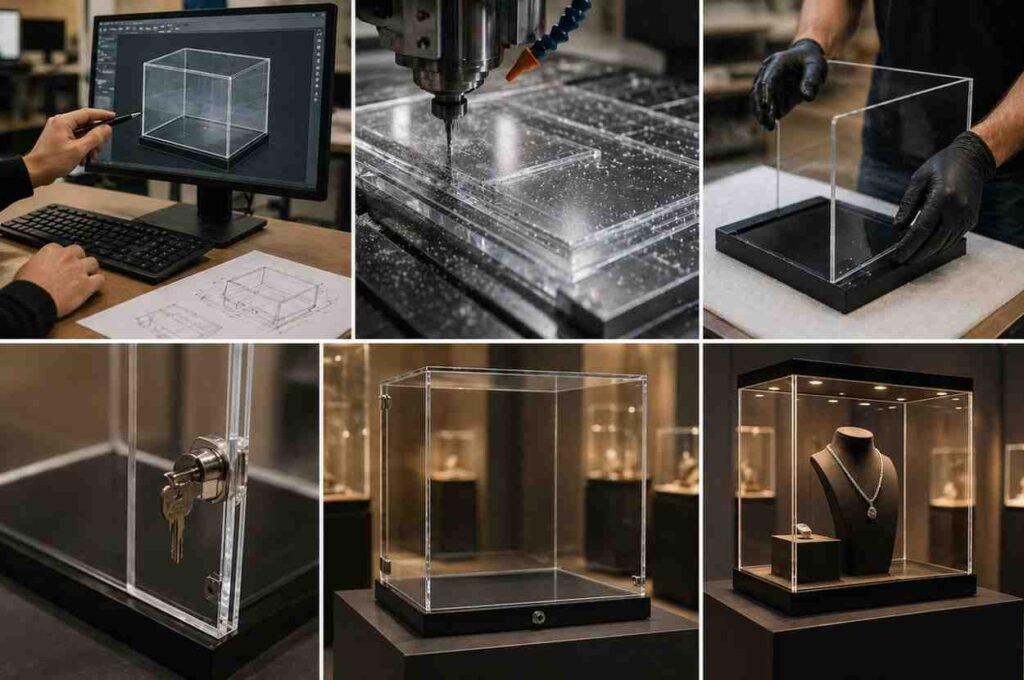
You measured the product. You measured the display area. But did you measure every doorway, hallway, elevator, and turn between the unloading point and the final location?
A custom display case can fit its intended space perfectly and still be impossible to install. Before ordering custom-sized acrylic display cases in Florida, check the complete delivery route and let its narrowest point guide the design.
Measure the Finished Case, Not Only the Displayed Item
The dimensions of your product determine how much internal space the case needs. They do not represent the final external size of the completed display.
Additional width, depth, or height may come from:
- Acrylic thickness
- A wood or acrylic base
- Locks, hinges, and handles
- Internal shelving
- Lighting components
- A pedestal or supporting cabinet
- Protective delivery packaging
Ask whether the dimensions shown in the design or quote are internal or external. For delivery planning, you need the complete outside measurements of the finished case.
Walk the Complete Delivery Route
Start where the case will be unloaded and follow the exact route it must take. Do not stop after measuring the main entrance.
Check Every Doorway
Measure the usable width and height with the door fully open. Account for the frame, threshold, handle, closer, and any other hardware extending into the opening. Check the exterior entrance, interior doors, and the entrance to the final room.
Allow Room for Hallway Turns
A case may pass through a doorway but become stuck at the next corner. Measure the hallway width and the available space on both sides of every turn.
Long or deep cases require enough room to rotate. This turning space can be more restrictive than the doorway itself.
Measure Stairs and Landings
Check the stair width, ceiling height, handrails, and landing depth. Look for low ceilings, hanging lights, and tight turns between flights.
A case may fit on the stairs but still can’t change direction at the landing.
Inspect the Elevator
If the delivery requires an elevator, record:
- Door width and height
- Interior width, depth, and height
- Available diagonal space
- Turning space outside the elevator
- Weight limit
Also check whether the building requires a freight elevator or booking.
Confirm the Final Placement
Measure the room entrance and the open area around the intended position. The case needs enough space to turn, lower, and place without hitting counters, walls, shelving, or permanent fixtures.
Let the Narrowest Point Guide the Design
The smallest or most difficult part of the route determines whether a case can be delivered fully assembled.
For example, a case may pass through a wide storefront entrance but fail at a narrow stockroom door. It may fit inside an elevator but leave no room to rotate when exiting.
Check the full delivery route before approving the final dimensions, including entrances, interior doorways, hallway turns, stairs, elevators, and the final room entrance. Pay particular attention to the tightest opening and any area where the case will need to turn or change direction.
Photos or a short video can also reveal obstructions that measurements alone may not explain.
Do Not Assume Tilting Will Solve the Problem
Tilting or rotating may help a case pass through an opening, but it is not suitable for every design.
Tilting may be unsafe or impractical when a case has a heavy attached base, fixed shelving, electrical components, or a high center of gravity. Diagonal clearance matters, but so do weight, balance, and construction. Confirm the handling method with the fabricator before delivery.
Include the Base and Packaging
The acrylic enclosure may fit through the door while its pedestal or delivery crate does not.
If the project includes a custom wood base, make sure the case fabricator and wood pedestal manufacturer serving Florida work from the same external dimensions and access restrictions. Confirm whether the cover and pedestal will arrive together or as separate components.
Protective packaging can also increase the delivery dimensions. Confirm the packaged size, where it can be removed, and who will handle placement. If unpacking must happen outside, identify a clean, sheltered area where the acrylic will not be scratched or damaged.
Change the Construction When Access Is Limited
Restricted access does not automatically mean you need a smaller display. The construction and delivery method may be adapted through custom plastic fabrication services for Florida projects.
Separate the Cover and Base
Transporting the acrylic enclosure and base separately can reduce the size and weight of each component. Both parts can then be positioned and connected inside the room.
Choose an Interlocking Display
An interlocking acrylic display case supplier serving Florida can fabricate an enclosure in smaller sections that pass through narrow doors, corridors, and elevators before assembly at the destination.
This may suit temporary exhibitions, restricted buildings, and displays that move between locations.
Divide One Display Into Coordinated Units
Several coordinated cases may be easier to deliver and rearrange than one oversized enclosure.
Plan for On-Site Assembly
Some custom cases can arrive as individual components for assembly inside the room. This must be decided before fabrication so the panels, connections, and access points are designed for that installation method.
Make Sure the Case Works After Installation
Getting the case into the room is not the final test. Staff must still be able to place, remove, and maintain the displayed items.
Check:
- Which side of the case opens
- Whether doors have room to swing
- Whether access panels can be removed
- How the displayed item will be placed inside
- Whether shelves can be taken out
- How lighting will be serviced
- Whether the case can be relocated later
A rear-opening case placed tightly against a wall may fit the floor plan but leave staff unable to access its contents.
Engraved LED displays also require access to an outlet, concealed cable routing, and enough room to service the lighting. Discuss these details when choosing an engraved LED display manufacturer serving Florida.
Museums have additional considerations. If you are comparing museum display case manufacturers for a Florida project, ask how the enclosure will be delivered, installed, opened, maintained, and moved for future exhibitions.
Send the Right Details Before Fabrication
Before requesting a quote, prepare:
- The displayed item’s width, depth, and height
- The clearance required around it
- The preferred external case dimensions
- The final display location
- The narrowest doorway measurements
- Hallway and corner dimensions
- Stair and elevator restrictions
- Details of the base, locks and lighting
- Photos or video of the delivery route
- Any building delivery requirements
Send this information with your enquiry so our team can consider the access restrictions when discussing the case dimensions and construction options.
Discuss My Display Case Requirements
Plan a Display Case That Can Reach Its Place
A successful custom display must fit the product, the room, and the route connecting them.
Instant Display Cases provides custom plastic fabrication services to clients throughout Florida, including custom-sized acrylic cases, interlocking displays, wood pedestal combinations, engraved LED displays, and museum enclosures.
Tell us what you need to display and where the finished case will be installed. We will discuss the dimensions and construction options for your project.
Request a Custom Display Case Quote
Frequently Asked Questions
How do you measure a doorway for a display case?
Measure the usable width and height inside the doorframe with the door fully open. Account for handles, closers, thresholds, and the turning space on both sides.
Do acrylic display cases come apart for moving?
Some cases can be designed with removable bases or interlocking sections. As an interlocking acrylic display case supplier serving Florida, we can discuss sectional construction when building access is limited.
Can a large display case be assembled inside the room?
Yes, when it is designed for on-site assembly. We can create custom-sized acrylic display cases for Florida projects in manageable sections when a fully assembled enclosure cannot pass through the building.
How do you move a large display case through a narrow door?
Depending on its construction, the case may be tilted, separated from its base, or delivered in sections. Confirm the appropriate handling method with the fabricator before delivery.
How much clearance is needed to move a display case?
Allow space for the case’s external dimensions, packaging, handling, and turns. Check every doorway, hallway, staircase, elevator, and room entrance.
What measurements are needed for a custom display case?
Provide the item’s dimensions, desired internal clearance, final installation area, and the narrowest points along the delivery route. Include photos or a short video when the route contains tight corners or stairs.