Too Heavy, Too Tall, or Unusually Shaped? How to Display Difficult Items
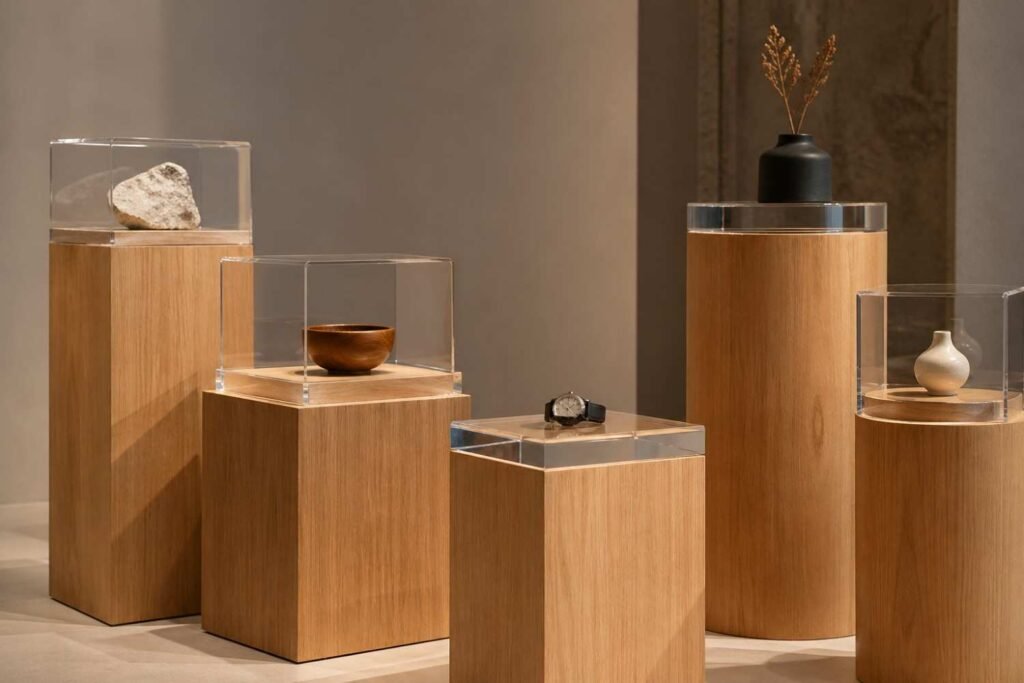
Some items are simply difficult to display properly. A helmet may roll, a tall trophy can look cramped, and a heavy sculpture may put too much stress on the shelf.
In these situations, “Will it fit inside the display case?” isn’t the only question. Weight, balance, support, viewing angle, and access all matter. Here’s how to handle these problems and choose a setup that works.
The Item Fits the Dimensions. So Why Does the Display Still Look Wrong?
Dimensions tell you if an object fits, but not whether it will display well. Too little clearance can make it look cramped, while too much space can make a small item feel lost.
Before choosing a case, consider:
- Dimensions: Measure the widest, tallest, and deepest points.
- Display position: Measure it as it will actually sit.
- Support: Include any stand, riser, mount, or base.
- Clearance: Leave enough space around the item.
- Access: Make sure it can pass through the case opening.
Plan around the complete display, not just the object’s measurements.
Too Heavy? Make Sure the Case Can Support It
Heavy items need the right support, not just enough space. A large trophy, sculpture, model, or piece of memorabilia may fit inside a case but still be too heavy for a standard shelf.
For heavier items, consider:
- placing the item on the case base;
- using a reinforced base or shelf;
- adding extra support; or
- using a pedestal for large pieces.
For large or heavy pieces, a properly sized pedestal can provide both support and a better viewing height. As a wood pedestal manufacturer in San Diego, we can build the pedestal around the item’s dimensions, weight, and intended presentation.
Too Tall? More Height Is Not Always the Answer
Tall trophies, sculptures, architectural models, instruments, and props may need more than extra headroom.
A top-heavy object can be unstable even when it fits easily inside the case. It may need a wider supporting base, discreet rear support, extra clearance around projections, or room for mounting hardware.
The goal is enough clearance for stability and presentation without making the case unnecessarily tall.
Won’t Sit or Stand? Solve the Support Problem First
Some objects were never designed to sit neatly on a flat shelf. Helmets, balls, masks, fossils, props, curved memorabilia, irregular sculptures, and objects with uneven bases may require additional support.
Useful options include:
- fitted cradles;
- acrylic stands;
- recessed holders;
- risers;
- shaped platforms; and
- discreet brackets or supports.
A helmet may need an elevated stand to hold it at a natural viewing angle. A ball needs something that stops it from rolling. A long prop may need support at more than one point.
With our custom plastic fabrication services in San Diego, we can create supports, risers, holders, and other display components around the item’s actual shape rather than relying on a standard fixture.
Plan these supports before finalizing case dimensions. Even a small mount can change the required height or depth.
Unusual Shape? Change the Orientation
A long item may fit better diagonally. An asymmetrical sculpture may look more natural and slightly off-center. A model may display better with one end raised. A narrow object may use space more efficiently when positioned vertically.
Try several arrangements before taking final measurements.
For movie prop displays in San Diego, we account for masks, helmets, costume pieces, miniature sets, models, and production props that require specific positioning or support.
Orientation and support can sometimes solve the problem without dramatically increasing the size of the case.
Need to See More Than the Front?
Some objects are meant to be viewed from several sides. Scale models, sculptures, prototypes, specimens, and detailed collectibles can lose much of their impact when pushed against an opaque back panel.
For these pieces, consider:
- clear sides;
- a clear rear panel;
- space around the object;
- a central pedestal; or
- a freestanding case that can be approached from different directions.
When we plan these displays, we consider where viewers will stand and which sides of the object need to remain visible. That helps us choose the right case layout, spacing, and viewing access.
Displaying Several Different-Sized Items?
A mixed collection can be tricky to arrange. One case may need to hold a tall trophy, smaller awards, a signed item, and several collectibles.
Lay the collection out before choosing the case. Test different groupings, shelf heights, risers, and spacing, then measure the arrangement as a whole.
When we plan displays for mixed collections, we look at how each piece relates to the others and leave practical room for future additions. This creates a more balanced arrangement while leaving practical room for additional pieces later.
Can You Actually Get the Item Into the Case?
An object may fit the internal dimensions yet still be difficult to install through a fixed opening. Before choosing the case, consider:
- whether the item needs to be tilted or rotated;
- whether a mount goes in with it;
- whether two people need room to handle it;
- whether shelves restrict access; and
- how the item will be removed later.
For larger or awkward pieces, we can use an interlocking display design that assembles around the item, giving you easier access during installation and removal.
Plan the opening and assembly method along with the case dimensions so the item can be placed safely and displayed as intended.
When Does a Custom-Sized Display Case Make Sense?
Not every difficult item needs a custom case. A standard display case works well when it provides enough room, suitable support, comfortable access, and the right viewing angles.
A custom-sized case becomes more useful when:
- One standard size is too small, and the next is unnecessarily large
- The item needs a special mount or base
- Several sides need to remain visible
- Fixed shelves interfere with the display
- The item is unusually heavy or tall
- The opening needs to accommodate an unusual shape
- Standard case proportions do not suit the object
We design custom display cases around how the object will actually be shown, supported, and accessed. This gives the piece the right fit, visibility, and stability.
Have an Item That Does Not Fit a Standard Display Case?
If your collectible, model, movie prop, trophy, sculpture, or other display piece is too tall, too heavy, unusually shaped, or difficult to position, Instant Display Cases Co. can create a display around its actual dimensions and presentation needs.
Share the item’s measurements, approximate weight, photos, and intended display position. We can use those details to determine the case dimensions, support, access, and pedestal requirements.
Have a difficult item to display? Contact Instant Display Cases Co. to discuss your project.
Frequently Asked Questions
How much bigger should a display case be than the item?
A display case should leave enough clearance for the item, its stand or mount, and comfortable viewing without making the object look lost. There is no single ideal gap because the right amount depends on the object’s shape, orientation, and installation.
Can an acrylic display case hold a heavy object?
Yes, but the case and its supporting surface need to suit the object’s actual weight. Acrylic thickness, panel dimensions, support spacing, and weight distribution all affect how the display should be constructed.
How do you display an object that will not stand up on its own?
Use a fitted stand, cradle, mount, recessed holder, or other support that stabilizes the object without hiding important details. The support should be planned before finalizing the case dimensions.
Can a display case be made for an unusually shaped item?
Yes. A custom-sized case can be planned around the item’s actual display position rather than standard dimensions. Any mount, projecting sections, viewing angles, and access requirements should also be considered.
Should a heavy object sit on a shelf or on the bottom of the display case?
For particularly heavy items, a properly supported base may be more practical than an elevated shelf. The best option depends on the object’s weight, contact points, shelf span, material thickness, and overall construction.
How do I measure an unusual object for a custom display case?
Measure its maximum height, width, and depth in the position in which it will actually be displayed. Include any pedestal, stand, mount, or support and allow enough room to safely install and remove the object.